
· Business
From black boxes to glass boxes: enterprise AI needs to explain (and measure) itself
Governed context, evals and traceability: three ideas that separate a flashy pilot from a system an executive committee can rely on.

There’s one question that sums up the moment we’re in quite well: “If the agent gives me a number, how do I know it’s the right one?” Nobody asks which model is behind it or how many parameters it has. They ask something much more basic and much harder: why should we trust it? What is this answer based on?
I’ve spent years building data systems and, lately, AI agents. And there’s something I see again and again: generating with AI is already cheap and fast. An analysis, a query or a report comes out in seconds. What’s expensive and slow is checking that what was generated is correct; in fact, people often skim the answer and send it on to a colleague or a client. Today the bottleneck isn’t producing, it’s reviewing and verifying. That’s why the challenge is no longer for AI to be able to answer, because it always answers, but for it to be able to explain how it reached its answer, and for us to be able to measure whether it’s correct quickly and safely.
Here are three ideas that, for me, separate a flashy pilot from a system an executive committee can rely on, one that lets you scale agents across the company.
1. From probabilistic to deterministic, thanks to context
A language model is probabilistic: faced with the same question, it can take different paths. That’s not a flaw, it’s its nature. The problem arises when that variability hits a business question that only has one correct answer.
An example: you ask an agent for last quarter’s margin. One day it gives you one figure and the next day, another. Is the model failing? Not exactly. What’s happening is that the company has two coexisting ways of calculating “net sales”: one deducts returns and volume rebates, the other only deducts returns. The model, with no further information, picks one or the other depending on how the question is phrased or which table it finds first.
Another example: “open order”. For Logistics it might be an order that hasn’t left the warehouse yet. For Finance, one that hasn’t been invoiced. For Customer service, any order with an open incident. If the agent doesn’t know which one applies in each case, any answer will be defensible and none will be reliable.
The solution isn’t to wait for a smarter model. The solution is to give it better governed context. By that I mean three very concrete things:
Validated business definitions: what “net sales”, “active customer” or “open order” mean, written once, reviewed by whoever owns that concept, and versioned.
A data map: which tables and fields represent each concept, how they relate to each other, and which is the source of truth as opposed to copies or historical snapshots.
Rules: which filters always apply, which combinations make no sense, and which questions require special permissions.
The model is still probabilistic. But when the context is well bounded, the space of possible answers shrinks so much that the system as a whole behaves predictably and deterministically. Same question, same definition, same data, same rules: same result. This is what takes you from a PoC to a production environment.
I like to think of it this way: we don’t make the model deterministic, we make the system deterministic. And context is what turns one into the other.
2. Without evals there’s no trust, only faith
Even if the context is well built, one question remains: how do we know it works, and that it keeps working after we change something?
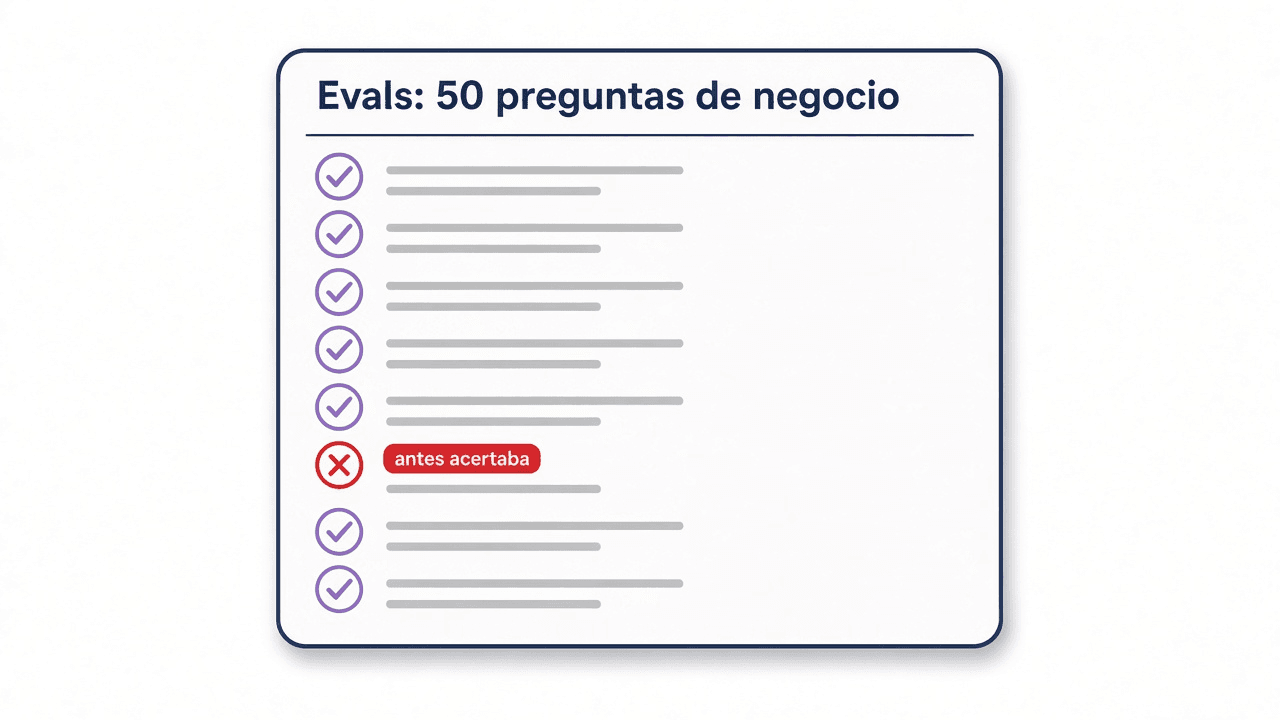
This is where evals come in. An eval is, in essence, a battery of real business questions with their expected answers. It’s what a good analyst would do to review a new colleague’s work. It’s like giving your systems an exam every so often to check that the answers are still correct and haven’t degraded.
Imagine 50 Finance questions: the gross margin of a product line, open orders at month end, net sales by region. For each one, someone from the area has written down the correct answer and how to get it.
There are two things I consider essential in a good eval:
Check the result. That the number matches, within whatever tolerance makes sense.
Check the path. That the agent used the right sources and applied the right rules and definitions. A correct number obtained from the wrong table, which matches today but won’t tomorrow, is a ticking time bomb.
And what turns evals into a practice rather than a one-off exercise: running them before every change, just like unit tests in software. If you change a definition, the data map, a rule or the model, you run the 50 questions again. If one that used to pass now fails, you know before the user does. Evals are the new TDD for agentic software.
With good evals, we can also switch to a cheaper, faster LLM and see how much our system degrades, so we can be efficient with tokens and keep costs under control.
Without this, every change is an act of faith, and when the answers end up driving business decisions, faith is not a strategy. That’s why I always sum it up the same way: without evals there’s no trust, only faith. On top of that, evals automate a good part of the verification that holds us back today: instead of reviewing every answer by hand, you review the battery once and run it every time. This brings consistency, safety and determinism to agentic systems.
A practical note: the best evals are written by the business people who ask those questions every week. They know which “easy” question hides a trap. Evals should be tough and adversarial, so they catch problems before our users or customers do.
3. From black boxes to agentic glass boxes
Good context and good evals greatly improve the quality of the answers. But in the enterprise it isn’t enough for an answer to be correct: you have to be able to prove it.
Another scenario: an auditor reviews a report and stops at a figure generated by an agent. They ask, quite rightly: “Where does this come from?” If the only possible answer is “the AI calculated it”, we have a serious problem. A trust problem and, in many sectors, a regulatory one too.
A black box gives answers. An agentic glass box also lets you see what happened inside. For me, that means being able to answer four questions for every answer:
Which sources the agent consulted: which systems, tables or documents it used, and when.
What knowledge it applied and who validated it: which definition of “net sales” or “open order” it used, in which version, and which business person approved it.
Which query it ran: the actual query, readable and reproducible, so any analyst can rerun it and get the same result.
With what permissions it did so: on whose behalf it acted and which data it had access to.
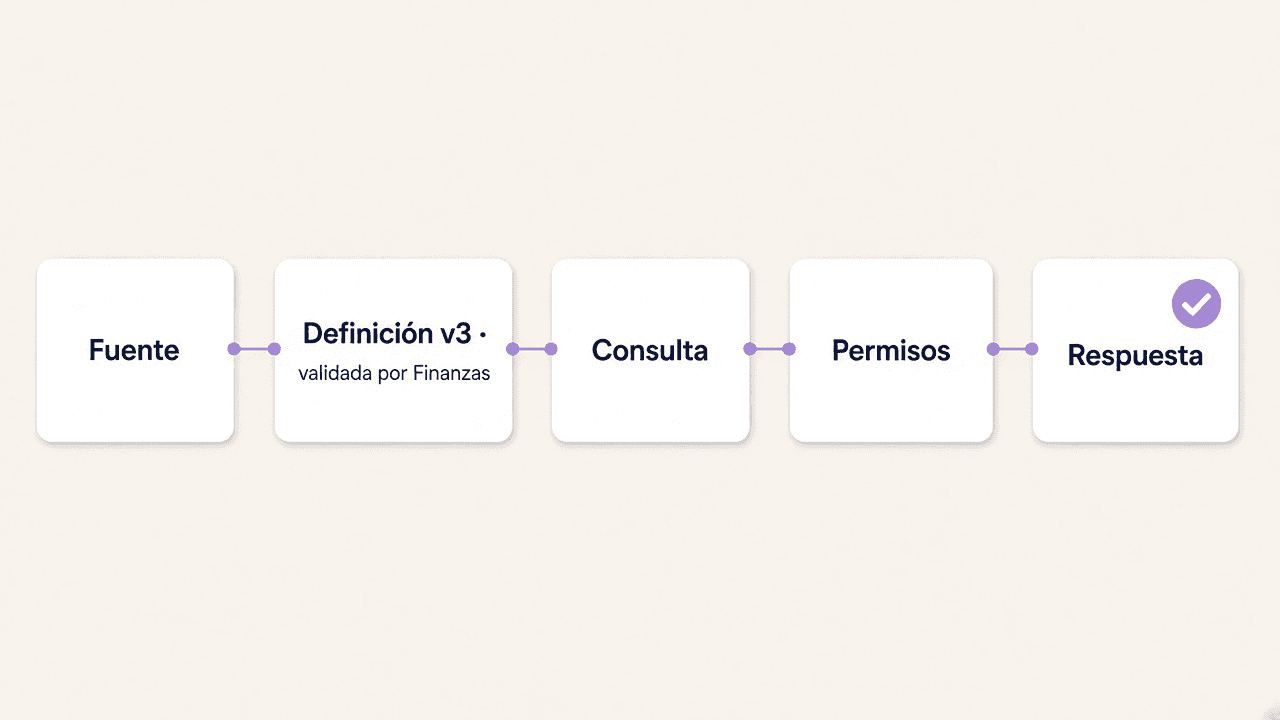
With that traceability, the conversation with the auditor changes completely. There’s no need to reconstruct by hand what might have happened: you just open the log for that answer and show the full path: source, definition, validation, query and permissions. What used to take hours of review becomes minutes, because the reasoning is out in the open. Explainability isn’t just transparency: it’s verification speed.
What’s more, when something goes wrong, the glass box tells you where. Was the definition wrong? Was the source out of date? Did the rule not cover a case? Every error becomes an improvement to the context and a new eval. All of this must be doable without friction and without having to export data or run SQL. In other words, a non-technical person should be able to fix bad context, bad reasoning or even bad data.
How the three pieces fit together
The three ideas form a cycle. Governed context makes the system predictable. Evals prove that it is, and warn you when it stops being so. Traceability lets you explain every answer and learn from every error. If one is missing, the system limps. It’s important for the context governance platform to provide these capabilities so it can keep up with the speed at which the business changes, which is usually faster than the speed at which the data changes.
In short
The next wave of AI in the enterprise won’t be won by the biggest model, but by the most explainable, best measured and most audited system.
Generating will keep getting cheaper; reviewing and verifying will remain the bottleneck. And the trust of a CFO, an auditor or an executive committee isn’t won with a more powerful model. It’s won with clear definitions, with tests that run on every change, and with the ability to show how every answer was reached.